
JLPT N2 Grammar – The difference between “〜に応えて” and “〜に応じて”

Table of Contents
1. The difference between “〜に応えて” and“〜に応じて”
2. Aに応えてB
3. Aに応じてB
4. Let’s Compare
5. Summary
6. Quiz
7. Similar Articles
8. Comments
Q: Do “〜に応えて” and “〜に応えて” have the same meaning?
A: Both have the meaning of “doing B in accordance with A,” but their usage is different.
“〜に応えて” is used when someone takes action in response to another person’s hope, request, or expectation in order to fulfill it.
On the other hand, “〜に応じて” is used when changing one’s response according to differences in conditions or situations.
Let’s look at how each one is used.
Aに応えてB (JLPT N2)
[Meaning]
To act in a way that meets the other person’s hope, request, or expectation
[Rule]
[N] Noun + に応えて
[Point]
It is used together with nouns that express another person’s hope or request, such as “質問 (questions),” “期待 (expectations),” and “要望 (requests).”
[Examples]
お客様のご要望に応えて、店にいすを増やしました。
In response to customer requests, we have added more chairs to the store.
⇒ The customer’s request to “increase the number of chairs” was fulfilled.
社長の期待に応えられるよう、社員達は頑張っています。
The employees are working hard to meet the president’s expectations.
⇒ Efforts are being made to meet the “president’s expectations'”.
皆様から質問に応えられるように、日頃から勉強をしています。
We study regularly to be able to answer everyone’s questions.
⇒ Efforts are being made to meet the “request for questions”.
Aに応じてB (JLPT N2)
[Meaning]
To change B according to the conditions of A
[Rule]
[N] Noun + に応じて
[Point]
It is used together with nouns that express differences in degree, type, or condition, such as “時間 (time),” “年齢 (age),” and “予算 (budget).”
[Examples]
可能な時間に応じて予約をお取りします。
We will schedule the reservation according to your availability.
⇒ If the time changes, the reservation time will also change.
お客様の予算に応じてパーティのプランが変えられます。
The party plan can be adjusted according to the customer’s budget.
⇒ If the budget changes, the plan will also change.
この学校では子供の年齢に応じて、ごはんを作っています。
In this school, meals are prepared according to the children’s ages.
⇒ If the children’s ages change, the content of their meals will also change.
Let’s Compare
Although the readings are different, both use the same kanji “応.”
This kanji has the image of responding in accordance with another person’s request or with a situation.
However, when they are used as grammar patterns, their meanings are slightly different.
[Aに応えてB]
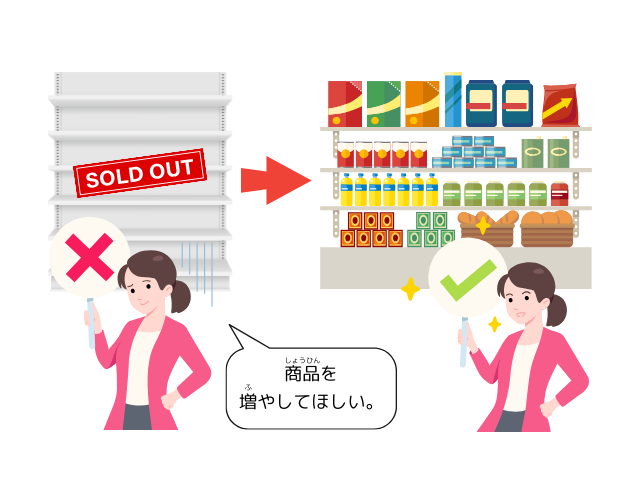
A contains things such as someone’s hope, request, expectation, or question. It expresses taking action so that what is asked for can be fulfilled. In other words, it means responding to something that another person has asked for or initiated.
[Example]
お客様のご要望に応えて、商品を増やしました。
In response to customer requests, we increased the number of products.
⇒ The customer’s request was ‘to increase the products,’ and the speaker fulfilled it.
[Aに応じてB]
A contains a condition, situation, or standard.
It expresses changing the response or content according to that condition.
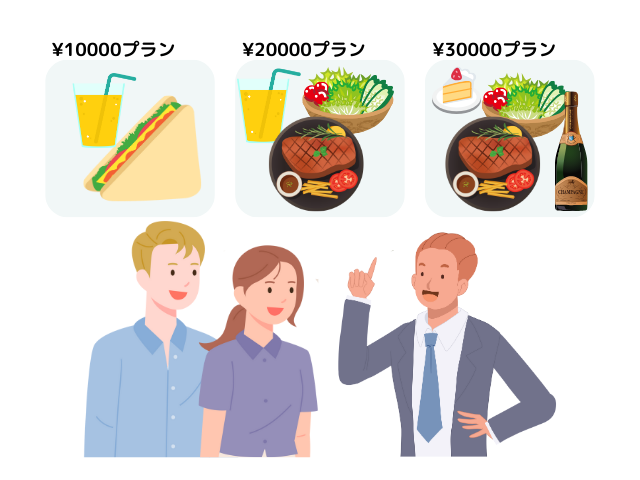
In other words, rather than fulfilling a request, it means adjusting something in accordance with a condition.
[Example]
お客様の予算に応じてパーティのプランが変えられます。
The party plan can be adjusted according to the customer’s budget.
⇒ The customer’s condition is ‘budget.’ The speaker adjusts the party plan accordingly.
Summary
[Aに応えてB]
- It expresses taking action in response to someone’s hope, request, expectation, question, or something similar.
[Aに応じてB]
- It expresses changing one’s response or the content according to a certain condition or situation.
Quiz
Read the following sentence and choose the expression that fits the context from the options provided in the parentheses.
Click on the question to check the answer.
A. に応えて
その歌手はファンのリクエストに応えて新しい曲を作りました。
The singer created a new song in response to the fans’ requests.
*”に応えて” is correct because the singer is fulfilling the fans’ request.A. に応じて
遠足のときは天候に応じて服装を変えられるようにしてください。
Please change your clothing according to the weather conditions during the excursion.
*”に応じて” is correct because the clothing is changed based on the weather conditions.A. に応えられる
選手は日本国民の期待に応えられるようにがんばると言いました。
The athlete said he would work hard to meet the expectations of the Japanese people.
*”に応えられる” is correct because the athlete wants to meet the expectations of the Japanese people.A. に応じて
季節に応じてメニューを変えて、お客様に喜んでいただいています。
We change the menu according to the season to please our customers.
*”に応じて” is correct because the menu is changed based on the season.Similar Articles
- JLPT N2 Grammar – The difference between “〜に応えて” and “〜に応じて”
- JLPT N1・N2 Grammar – The difference between “〜なくもない” and “〜ないこともない”
- JLPT N1・N2 Grammar – The difference between ”以上” and “手前”
- JLPT N2 Grammar – The difference between “〜まい” and “〜ものか”
- JLPT N2・N3 Grammar – The difference between “〜恐れがある” and “〜かねない”
▼ Subscribe to Our Newsletter ▼
Receive free tips for learning Japanese!


