JLPT N2 Grammar – Difference between “〜ものの” and “〜ものか”

Table of Contents
1. Difference between “〜ものの” and “〜ものか”
2. ものの
3. ものか
4. Let’s Compare
5. Summary
6. Similar Articles
7. Comment
Q: What is the difference between “〜ものの” and “〜ものか”?
A: “〜ものの” is used as a concessive conjunction, while “〜ものか” appears at the end of a sentence. Their meanings are completely different, so it’s important to understand them properly and use them correctly.
ものの (JLPT N2)
[Meaning]
“~ but, however”
Used to state a fact, followed by a result that differs from expectations or predictions
[Rules]
[V] Verb plain form + ものの
[A] い adjective plain form + ものの
[Na] な adjective + ものの
[Na] な adjective + である + ものの
[N] Noun + である + ものの
[Examples]
アメリカに3年留学したものの、上手に英語が話せません。
I studied abroad in America for three years, but I still can’t speak English fluently.
犬はかわいいものの、世話が大変です。
Dogs are cute, but taking care of them is difficult.
この店の接客は丁寧なものの、料理はあまりおいしくないですね。
The customer service at this restaurant is polite, but the food is not very good.
この地域は観光地であるものの、平日は人が少ないです。
This area is a tourist destination, but there are few people on weekdays.
ものか (JLPT N2)
[Meaning]
Expresses strong negation, meaning “absolutely not” or “never”.
It is an emotional expression, often carrying a nuance of surprise or rebuttal.
[Rules]
[V] Verb plain form + ものか / もんか
[A] い adjective plain form + ものか / もんか
[Na] な adjective + ものか / もんか
[Na] な adjective plain form + ものか / もんか
[N] Noun + な + ものか / もんか
[N] Noun plain form + ものか / もんか
[Examples]
お父さんとは二度と話すもんか。
I will never talk to my father again!
A:そのカメラ、安かった?
B:安いものか。10万円もしたよ。
A: Was that camera cheap?
B: Cheap? No way! It cost 100,000 yen.
こんなことで諦めるものか。最後までやり抜くぞ!
There’s no way I’m giving up over something like this. I’ll see it through to the end!
こんな失礼な対応、許すもんか!
I will never forgive such rude behavior!
*In spoken language, “もんか” is often used.
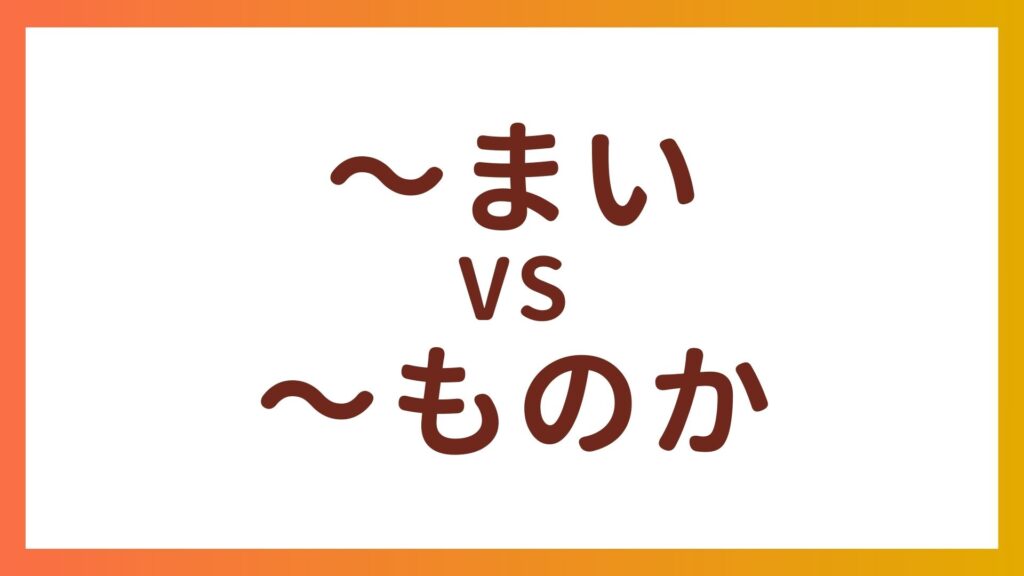
Similarly, “〜まい” is also placed at the end of a sentence to express negation.
To learn the difference between
“ものか” and “〜まい”, read this article:
Let’s Compare
[AもののB]
“〜ものの” is a concessive conjunction used to express “A is a fact, but in reality, B occurs, which is different from what would be expected from A.”
[Key Points]
・Used in the form “AもののB”, where there is a discrepancy between A and B in terms of causality.
・Not commonly used in spoken language but frequently appears in written Japanese.
・Can be used in formal situations and business contexts.
[Examples]
アメリカに3年留学したものの、上手に英語が話せません。
I studied abroad in America for three years, but I still can’t speak English fluently.
⇒ Studying abroad for three years would typically lead to fluency in English, but in reality, that did not happen.
この大会は世界的なイベントであるものの、日本ではあまり知られていません。
Although this tournament is a global event, it is not well known in Japan.
⇒ The expectation is that a global event would be widely recognized in Japan as well, but that is not the case.
頭では分かっているものの、なかなか行動できないんです。
I understand it in my head, but I just can’t take action.
⇒ The speaker understands what should be done, but in reality, they are unable to act on it.
[ものか]
“ものか” is a sentence-ending expression that conveys strong negation. It has a more emotional tone than a standard negative sentence and expresses the speaker’s strong resistance or determination.
While it is generally used by men, women may also use it depending on the situation.
Additionally, it is often used with adverbs such as “絶対(に)” (absolutely), “決して” (never), and “二度と” (never again) to emphasize firm denial.
[Key Points]
・Used for strong emotional negation.
・Conveys a nuance of “absolutely not” or “never”.
・In spoken language, “もんか” is also commonly used.
[Examples]
お父さんとは二度と話すもんか。
I will never talk to my father again!
⇒ The speaker expresses a strong determination never to speak with their father.
ここで成功するまでは決して国へ帰るものか。
I will never return to my country until I succeed here.
⇒ The speaker shows a strong determination not to return home until they achieve success.
A: そのパズルって簡単だった?
B: 簡単なもんか。完成するのに1年もかかったよ。
A: Was that puzzle easy?
B: Easy? No way! It took me a whole year to complete it.
⇒ The speaker strongly denies that the puzzle was easy.
Summary
[〜ものの]
- Used as a concessive conjunction, meaning “Although A is true, the expected outcome does not follow.”
[〜ものか]
- Placed at the end of a sentence to strongly emphasize negation. It expresses the speaker’s firm refusal or denial, often carrying an emotional nuance.
Quiz
Read the following sentence and choose the expression that fits the context from the options provided in the parentheses.
Click on the question to check the answer.
A. ものか
なんてひどいサービスのレストランなんだ。もう絶対に来るものか。
What a terrible service this restaurant has! I will never come here again.
*”ものか” is correct because it expresses a strong denial of returning to the restaurant.
A. ものの
ピアノを習い始めたものの練習を怠けてしまいます。
I started learning the piano, but I ended up neglecting my practice.
*”ものの” is correct because it indicates a contrast: starting piano lessons implies practicing, but the expected outcome did not happen.
A. ものの
一人暮らしは楽しいものの寂しさもあります。
Living alone is fun, but there are also moments of loneliness.
*”ものの” is correct because it shows a contrast between the enjoyment of living alone and the unexpected loneliness.
A. もんか
どんなに大変でも諦めるもんか。絶対に最後までやるぞ。
No matter how hard it gets, I will never give up. I will see it through to the end!
*”もんか” is correct because it expresses a strong determination not to give up.
Similar Articles
- JLPT N1・N2 Grammar – The difference between “〜なくもない” and “〜ないこともない”
- JLPT N1・N2 Grammar – The difference between ”以上” and “手前”
- JLPT N2 Grammar – The difference between “〜まい” and “〜ものか”
- JLPT N2・N3 Grammar – The difference between “〜恐れがある” and “〜かねない”
- JLPT N1・N2 Grammar – The difference between “とりあえず” and “一応”
▼Sign Up for News Letter▼
Get free tips for learning Japanese!


