JLPT N3・N4 Grammar – Difference between “〜あいだに”and “〜うちに”

Table of Contents
1. Difference between “〜あいだに”and “〜うちに”
2. 〜あいだに
3. 〜うちに
4. 〜あいだに VS 〜うちに
5. AうちにB
6. Summary
7. Quiz
8. Similar Articles
9. Comment
Q: Are there any differences between “〜あいだに” and “〜うちに”?
A: “〜あいだに” and “〜うちに” both indicate a certain time or period, but they need to be used differently depending on the context of the following sentence.
〜あいだに (JLPT N4)
[Meaning]
B happens during the period of A
[Rules]
[V] Verb Dictionary form +あいだに
[V] Verb ている form+あいだに
[A] い adjective+あいだに
[Na] な adjective+な+あいだに
[N] Noun+の+あいだに
[Examples]
[V] 日本にいるあいだに富士山に登りたいです。
While I’m in Japan, I want to climb Mt. Fuji.
[V] 寝ているあいだに蚊にさされました。
I got bitten by a mosquito while I was sleeping.
[A] 昼休み前の人が少ないあいだにを食事をしてきました。
I had a meal while there were few people before lunchtime.
[Na] 信号を待つわずかなあいだに事故が起こりました。
An accident happened in a short time while waiting for the traffic light.
[N] 夏のあいだにダイエットをしよう。
Let’s go on a diet over the summer.
〜うちに (JLPT N3)
[Meaning]
B happens during the period when A’s state continues.
[Rules]
[V] Verb Dictionary form・ない form+うちに
[A] い adjective+うちに
[Na] な adjective+な+うちに
[N] Noun+の+うちに
[Examples]
[V] 日本にいるうちに富士山に登りたいです。
While I’m in Japan, I want to climb Mt. Fuji.
[V] 友達とゲームしているうちに夜になっていました。
While I was playing games with my friends, it became night.
[V] 暗くならないうちに帰ったほうがいいですよ。
You should go home before it gets dark.
[A] 若いうちに勉強しておいたほうがいいですよ。
It’s better to study while you are young.
[Na] 桜がきれいなうちに写真をたくさんとろう。
Let’s take lots of photos while the cherry blossoms are beautiful.
[N] 学生のうちに色々なところへ行きたいなあ。
While I’m still a student, I want to visit many places.
[N] 晴れのうちに洗濯物を干そう。
Let’s hang out the laundry while it’s sunny.
For those who want to learn in detail about the usage of “〜うちに” and “途中で,”
please read this article.
〜あいだに VS 〜うちに
These expressions indicate a “period,” referring to the occurrence of B during a certain period or state of A. Although both can be used in some cases, switching them can sometimes sound unnatural.
Let’s explore these differences.
[Example]
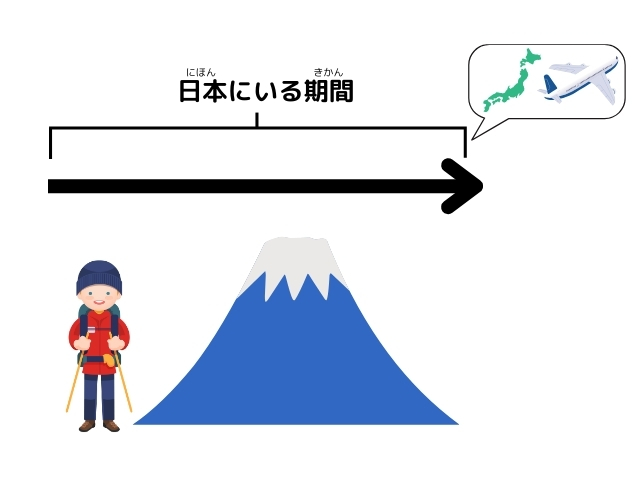
◯ 日本にいるあいだに富士山に登りたいです。
◯ 日本にいるうちに富士山に登りたいです。
While I’m in Japan, I want to climb Mt. Fuji.
⇒ The time span refers to “before leaving Japan,” indicating the desire to climb Mt. Fuji within that period.
You might think that you can use either one, but how about in the following situations?
[Example]
◯ 電車を待っているあいだにジュースを飲みました。
× 電車を待っているうちにジュースを飲みました。
While waiting for the train, I drank some juice.
This is an appropriate use of “〜あいだに“.
The reason is that “〜あいだに” is commonly used for “a clearly defined period,” and since train schedules are definite, using “〜うちに” would result in an unnatural sentence.
Let’s look at other examples.
[Example]
◯ 昼休憩のあいだに銀行へ行きました。
× 昼休憩のうちに銀行へ行きました。
During the lunch break, I went to the bank.
This too is appropriate to use “〜あいだに” because lunch breaks have a fixed time.
Also, events that occurred at a certain point during an ongoing activity by the speaker can also use “〜あいだに.”
[Example]
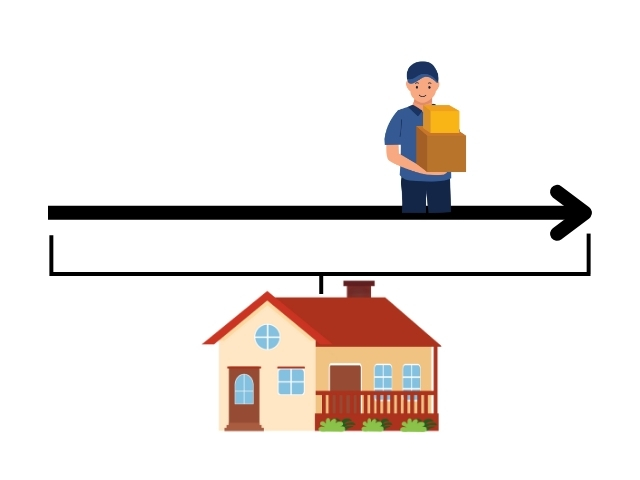
わたしが留守のあいだに宅配が来たようです。
It seems that a delivery arrived while I was out.
AうちにB
Next, let’s look at “〜うちに.”
Unlike “〜あいだに,” the meaning changes slightly, so let’s divide it into two parts to understand it better.
[① Opportunity]
Both of these express a “period,” but the way this period is perceived differs depending on the speaker.
[Example]
日本にいるあいだに富士山に登りたいです。
日本にいるうちに富士山に登りたいです。
While I’m in Japan, I want to climb Mt. Fuji.
In these two cases, both are acceptable, but “〜うちに” differs from “〜あいだに” in that it expresses a “somewhat indefinite period.”
Additionally, it conveys the speaker’s feeling that “if B is not done before the period or state of A ends, the opportunity to do B will be lost.”
[Examples]
日本にいるうちに富士山に登りたいです。
While I’m in Japan, I want to climb Mt. Fuji.
⇒ This indicates that if you leave Japan, you will lose the opportunity to climb Mount Fuji.
桜がきれいなうちに花見へ行こう。
While the cherry blossoms are still beautiful, let’s go to a flower viewing.
⇒ This indicates that if the cherry blossoms are no longer beautiful, you will lose the opportunity to enjoy hanami (cherry blossom viewing).
Also, when expressing the speaker’s feelings in this way, it is often used with the “negative form of a verb (indicating change).”
[Examples]
桜が散らないうちに花見へ行こう。
Let’s go to a flower viewing before the cherry blossoms fall.
アイスが溶けないうちに食べたほうがいいよ。
You should eat the ice cream before it melts.
[② Another Event]
The second case is when another event occurs within the same period as the speaker’s timeframe.
This event represents something the speaker was unaware of or an unexpected result.
[Example]
友達とゲームとゲームしているうちに夜になっていました。
While playing games with my friends, it became night.
⇒ This indicates that the speaker was playing a game and didn’t realize it had become nighttime.
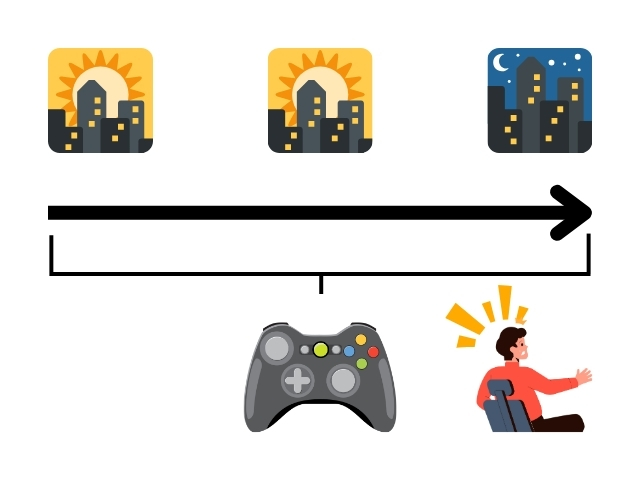
Other expressions like this are also possible.
[Examples]
映画を見ているうちに寝てしまいました。
I fell asleep while watching the movie.
道に迷っているうちに全然知らないところへ来てしまいました。
While I was lost, I ended up in a completely unfamiliar place.
しばらく見ないうちにいとこの背はわたしより高くなっていました。
While I hadn’t seen them for a while, my cousin grew taller than me.
For example, the sentence “留守のあいだに、宅配が来たようです” (It seems that a delivery arrived while I was out) using “〜あいだに” might seem like something the speaker was unaware of, but “〜あいだに” represents a specific point within the period.
In contrast, “〜うちに” is used for something that occurred simultaneously with the speaker’s ongoing action, so be careful about this distinction.
Summary
〜あいだに
- It is used for a “clearly defined period.”
〜うちに
- It is often used for a “somewhat indefinite period,” and the speaker’s feeling that “if something is not done within this period or state, the opportunity will be lost” is included.
- It also represents another event that occurred within the same period as the speaker’s action (something the speaker was unaware of or an unexpected result).
Quiz
Read the following sentence and choose the expression that fits the context from the options provided in the parentheses.
Click on the question to check the answer.
A. うちに
父が元気なうちに家族で旅行に行こう。
While my father is still healthy, let’s take a family trip.
*The state of the father being healthy is not a clearly defined period. Additionally, it includes the implication of not wanting to lose the opportunity to travel with the father, so “うちに” is appropriate.
A. あいだに
春休みのあいだに旅行でも行こうかな。
During spring break, maybe I’ll go on a trip.
*The spring break period is clearly defined. Moreover, the speaker uses an ambiguous expression like “~かな,” so “あいだに” is appropriate.
A. うちに
料理が冷めないうちに食べてくださいね。
Please eat the food before it gets cold.
*It is used with the ない form of a verb indicating change. Additionally, it includes the implication of not wanting to lose the opportunity to eat warm food, so “うちに” is appropriate.
A. あいだに
旅行しているあいだに家に泥棒が入りました。
While we were traveling, a burglar broke into our house.
*The “period of traveling” is clearly defined. Moreover, it occurs at a certain point within that period, so “あいだに” is appropriate.
Similar Articles
- JLPT N4 Grammar – The difference between “〜ようにする” and “〜ことにする”
- JLPT N2・N3 Grammar – The difference between “〜に従って” and “〜に沿って”
- JLPT N2・N3 Grammar – The difference between “〜に関して” and “〜をめぐって”

- JLPT N2・N3 Grammar – The difference between “〜わりに” and “〜にしては”
- JLPT N2・N4 Vocabulary – The difference between “冷える” and “冷やす”