
JLPT N4 Grammar – Difference between the “Potential Form” and “〜ことができる”

Table of Contents
1. Difference between the “Potential Form” and “〜ことができる”
2. How to form the Potential Form
3. ~ことができる
4. What does “Potential” Mean?
5. Let’s Compare
6. Summary
7. Similer Articles
8. Comment
Q: Can “〜ことができる” and the potential form be used interchangeably?
A: Basically, the potential form and “〜ことができる” can be used interchangeably, and there’s no major difference in meaning. However, the potential form is more commonly used in natural, spoken language. On the other hand, “〜ことができる” sounds a bit more formal and tends to appear in written documents or more polite contexts.
How to form the Potential Form
Group 1 (Godan verbs)
Change the vowel [u] of the verb stem to [e] and add “る”
[Examples]
買う → 買える
飲む → 飲める
Group 2 (Ichidan verbs)
Add “られる” to the verb stem.
[Examples]
食べる → 食べられる
いる → いられる
Group 3 (Irregular verbs)
There are only two irregular verbs to memorize as a whole.
[Examples]
来る → 来られる
する → できる
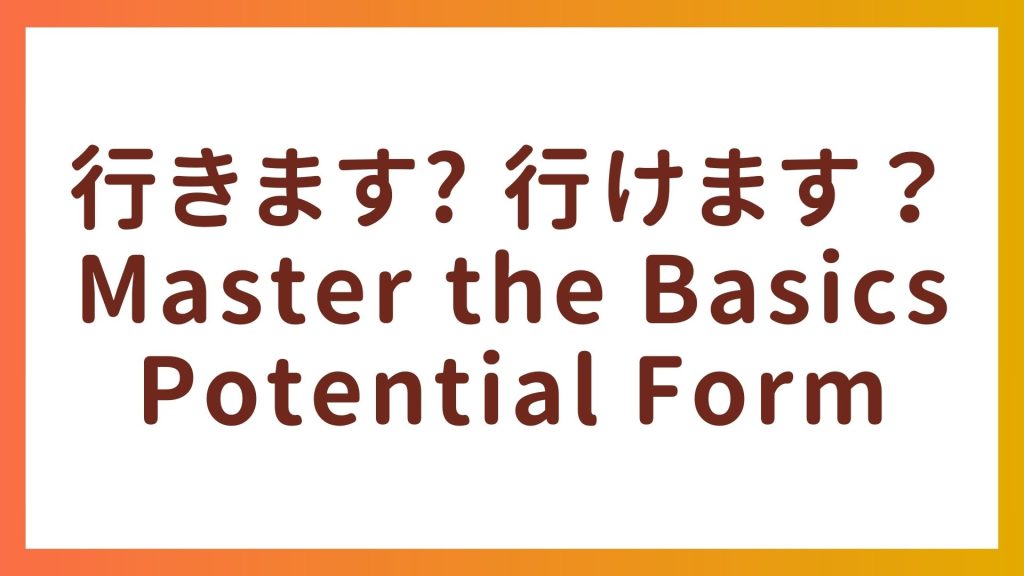
If you want to learn about the basics
of the potential form,
please read this article.

There are also some verbs that cannot be
made into the potential form.
For more details, please read this article.
~ことができる
“〜ことができる” is a construction that expresses “potential” by attaching “ことができる” to the dictionary form of a verb.
[Examples]
買うことができる(=買える)
食べることができる(=食べられる)
買い物することができる(=買い物できる)
“ことができる” has a somewhat formal tone. It’s often used when you want to speak politely or when writing.
What does “Potential” Mean?
Both the potential form and “〜ことができる” express two main meanings: “technical or physical ability” and “possibility or impossibility of performing an action.”
[Examples] Technical or physical ability
鈴木さんは3か国語を話せます。
Mr. Suzuki can speak three languages.
鈴木さんは3か国語を話すことができます。
Mr. Suzuki is able to speak three languages.
健康でいれば、年をとっても走れます。
If you are healthy, you can run even when you get older.
健康でいれば、年をとっても走ることができます。
If you are healthy, you’re still able to run even as you age.
[Examples] Possibility or impossibility of an action
新幹線でたばこを吸えません。
You cannot smoke on the Shinkansen.
新幹線でたばこを吸うことができません。
You are not allowed to smoke on the Shinkansen.
公園でお酒を飲めます。
You can drink alcohol in the park.
公園でお酒を飲むことができます。
You are allowed to drink alcohol in the park.
In either case, there’s no difference in meaning between the “potential form” and “〜ことができる.” However, “〜ことができる” has a slightly more formal nuance, while the “potential form” is often used as a natural, spoken expression.
Let’s Compare
Let’s take a look at the basic sentence patterns while paying attention to the use of particles.
[Person/Thing は Dictionary Form + ことができる]
[Examples]
わたしは速く走ることができます。
I can run fast.
スミスさんは日本語を話すことができます。
Mr. Smith can speak Japanese.
このカフェではたばこを吸うことができます。
You can smoke in this cafe.
[Person/Thing は Potential Form]
[Examples]
わたしは速く走れます。
I can run fast.
スミスさんは日本語を話せます。
Mr. Smith can speak Japanese.
このカフェではたばこが吸えます。
You can smoke in this cafe.
In fact, the sentence pattern “することができる” can expand the range of expression by changing “する” into an auxiliary verb or by replacing the “が” particle with other particles.
[Examples]
この広場ではスポーツしたりBBQしたりすることができます。
In this square, you can do things like play sports or have a BBQ.
⇒ This shows a rephrasing using an auxiliary verb.
わたしは歩くこともできません。
I can’t even walk.
わたしは歩くことすらできません。
I can’t do something as simple as walking.
⇒ These uses particles other than “が” for emphasis.
このカフェではたばこを吸うことも、通話することもできないんです。
You can’t smoke or make calls in this cafe.
⇒ This conveys multiple prohibitions.
英語は話すことができますが、中国語は話すことができません。
I can speak English, but I can’t speak Chinese.
⇒ In this case, it can also be rephrased using the potential form: “英語は話せますが、中国語は話せません。”
Summary
- There isn’t a big difference between the potential form and “ことができる,” but “ことができる” has a slightly more formal tone compared to the potential form, which is more common in spoken language.
- The potential form expresses two main ideas: technical/physical ability and whether an action can be performed or not.
- When using auxiliary verbs or changing particles, “ことができる” is often more naturally used.
Similer Articles
- JLPT N3・N4 Grammar – The difference between “〜あいだに”and “〜うちに”
- JLPT N4 Grammar – The difference between”〜みたいな” and “〜みたいに”
- JLPT N4 Grammar – The difference between “〜ようにする” and “〜ことにする”
- JLPT N2・N4 Vocabulary – The difference between “冷える” and “冷やす”
- JLPT N4・N5 Vocabulary – Difference between the counter “回” and “度”
▼ Subscribe to Our Newsletter ▼
Receive free tips for learning Japanese!


