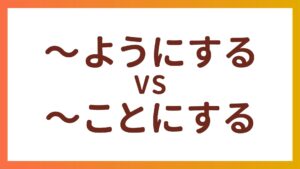
JLPT N4 Grammar – The difference between “〜ようにする” and “〜ことにする”

Table of Contents
1. The difference between “〜ようにする” and “〜ことにする”
2. 〜ようにする
3. 〜ことにする
4. Let’s Compare
5. Summary
6. Quiz
7. Similar Articles
8. Comments
Q: Can you explain how to use “〜ようにします” and “〜ことにします”?
A: The difference between “〜ようにする” and “〜ことにする” lies in whether the speaker is making a habitual effort or expressing something they have decided by their own will.
Let’s take a closer look.
〜ようにする (JLPT N4)
[Meaning]
Indicates something the speaker tries to do as a habit
[Rules]
[V] Verb dictionary form + ようにする
[V] Verb ない form + ようにする
[Examples]
これから朝5時に起きるようにします。
I will try to wake up at 5 AM from now on.
チョコレートのような甘いものは食べないようにしています。
I try not to eat sweet things like chocolate.
⇒ “〜ようにしている” expresses a habit that is currently continuing.
健康のために、エレベーターではなく階段を使うようにしています。
I try to use the stairs instead of the elevator for my health.
When talking about another person’s habits or efforts, you can use “〜ようだ” to describe what it seems like, or “〜そうだ” to report information you have heard.
[Examples]
母はダイエットのために、あまいものを食べないようにしているようです。
My mother seems to be avoiding sweets in her diet.
木村さんは朝早く出勤するようにしているそうです。
I heard that Mr. Kimura tries to go to work early in the morning.
You can also use this expression when asking someone to make something a habit.
[Examples]
学校のルールは守るようにしましょう。
Let’s make sure to follow the school rules.
会社を休むときは、メールで連絡するようにしてください。
Please notify us by email if you are absent from work.
〜ことにする (JLPT N4)
[Meaning]
Indicates something the speaker has decided based on their own judgment or intention
[Rules]
[V] Verb Dictionary form + ことにする
[V] Verb ない form + ことにする
[Examples]
今日は疲れているので、早く寝ることにします。
I have decided to go to bed early today because I am tired.
これから朝5時に起きることにしました。
I have decided to start waking up at 5 AM from now on.
健康のためにタバコをやめることにしました。
I decided to quit smoking for my health.
When talking about another person’s decision, you can use “〜ようだ” to describe what it seems like, or “〜そうだ” to report information you have heard, just as with “〜ようにする”.
[Examples]
トムさんは国へ帰ることにしたようです。
Tom seems to have decided to return to his home country.
社長は引退することにしたそうです。
The president has decided to retire.
[Cannot be used to give instructions]
“〜ことにする” expresses a decision made by the speaker, so it cannot be used when asking someone else to do something.
[Examples]
〇 先生に怒られてわたしは学校のルールを守ることにしました。
After being scolded by the teacher, I decided to follow the school rules.
⇒ This expresses the speaker’s decision.
×(先生が生徒に)学校のルールを守ることにしましょう。
(Teacher to student) Let’s follow the school rules.
In this case, it should be expressed like this:
学校のルールは守るようにしましょう。
Let’s make sure to follow the school rules.
Let’s Compare
Even when the content is the same, the nuance changes depending on whether you use “〜ようにする” or “〜ことにする”.
[Examples]
これから朝5時に起きるようにします。
I will start waking up at 5 AM from now on.
⇒ This expresses an effort to make something a habit.
これから朝5時にことにします。
I have decided to start waking up at 5 AM from now on.
⇒ This expresses a decision made by the speaker’s own will.
In this way, “〜ようにする” expresses habitual effort, while “〜ことにする” expresses a decision based on the speaker’s intention or judgment.
[Major life decisions]
When talking about major decisions in life—such as education, employment, or marriage—“〜ことにする” is usually used.
[Examples]
中国語の勉強のために、北京の大学へ留学することにしました。
I have decided to study abroad at a university in Beijing to learn Chinese.
3年交際している彼と結婚することにしました。
I have decided to marry my boyfriend after dating for three years.
Summary
[〜ようにする]
- Indicates that the speaker is consciously making an effort to continue an action as a habit.
- It carries the nuance of “trying to make something a regular practice from now on.”
- It is often used when talking about daily habits or self-management.
- The form “〜ようにしています” is also commonly used to describe a habit that is currently continuing.
[〜ことにする]
- Indicates something the speaker has decided to do (or not do) based on their own intention or judgment.
- It is used to show a decision that the speaker has reached after thinking about it.
- It is often used when talking about relatively important decisions, such as education, employment, moving, or marriage.
- It cannot be used when asking someone else to take an action.
Quiz
Read the following sentence and choose the expression that fits the context from the options provided in the parentheses.
Click on the question to check the answer.
A. ことにしました
仕事のために来月から東京に住むことにしました。
I have decided to live in Tokyo from next month for work.
*The decision to live in Tokyo reflects the speaker’s will, which is why “ことにしました” is appropriate.
A. ようにしてください
気分が悪いときはこの薬を飲むようにしてください。
Please take this medicine when you feel unwell.
*In the context of requesting someone to take the medicine, “ようにしてください” is the correct choice.
A. ことにしました
夫と話して離婚することにしました。
I have decided to divorce my husband after discussing it with him.
*Since divorce is a one-time important decision, “ことにしました” is the right option to express the speaker’s determination.
A. ようにしています
夜遅い時間にはご飯を食べないようにしています。
I try not to eat dinner too late at night.
*As for the habitual effort of not eating late at night, “ようにしています” is the appropriate expression.
関連記事
- JLPT N3・N4 Grammar – The difference between “〜あいだに”and “〜うちに”
- JLPT N4 Grammar – The difference between”〜みたいな” and “〜みたいに”
- JLPT N4 Grammar – The difference between “〜ようにする” and “〜ことにする”
- JLPT N2・N4 Vocabulary – The difference between “冷える” and “冷やす”
- JLPT N4・N5 Vocabulary – Difference between the counter “回” and “度”
▼ Subscribe to Our Newsletter ▼
Receive free tips for learning Japanese!


It explained very well and made everything clear. Thanks!
We’re glad to hear that! Thank you:)