
JLPT N0・N1 Grammar – The Difference between “〜きらいがある” and “〜ふしがある”
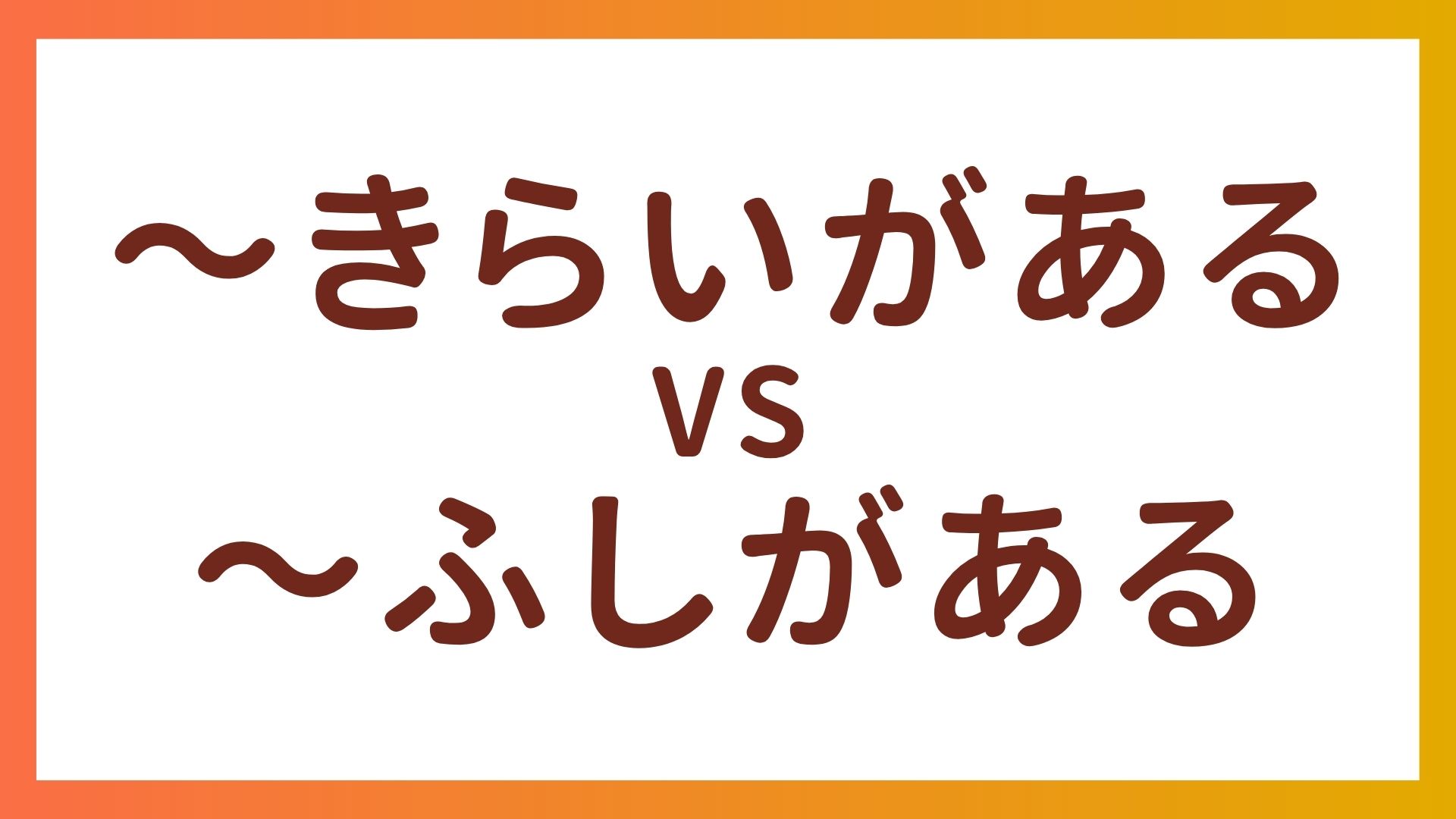
Table of Contents
1. The Difference between “〜きらいがある” and “〜ふしがある”
2. 〜きらいがある
3. 〜ふしがある
4. Let’s Compare
5. Summary
6. Similar Articles
7. Comments
Q: Is there a difference between “〜きらいがある” and “〜ふしがある”?
A: Yes. Both expressions show the speaker’s judgment, but “〜きらいがある” is used to point out a negative tendency, while “〜ふしがある” is used to show, in a soft way, that something seems that way without making a strong statement.
〜きらいがある (JLPT N1)
[Meaning]
This expression is used when the speaker points out an undesirable tendency or a problem in someone’s behavior, way of thinking, or attitude
[Rule]
[V] Verb dictionary form / ない form + きらいがある
[N] Noun + の + きらいがある
[Examples]
彼は自分の意見を押し通すきらいがある。
He has a tendency to push his own opinion.
この会社は変化を避けるきらいがあります。
This company has a tendency to avoid change.
日本人は曖昧な言い方を好むきらいがある。
Japanese people have a tendency to like vague expressions.
彼女は慎重になりすぎるきらいがあるね。
She has a tendency to be too careful.
“〜きらいがある” carries a slightly judgmental tone. It is used to softly criticize by saying that someone has “a bit of that bad tendency” or “a habit like that.”
Rather than strongly blaming the person, it suggests the nuance of “it cannot be said that they have no such side.” It is often used for people, groups, or ways of thinking.
It appears in daily conversation, but is also common in written or explanatory contexts.
[Examples]
彼は何でもすぐにあきらめるきらいがあります。
He has a tendency to give up quickly.
彼女は人に頼むのを嫌がるきらいがあります。
She has a tendency to dislike asking others for help.
〜ふしがある (JLPT N0)
[Meaning]
This expression is used to gently show a guess or awareness, meaning “I cannot say it clearly, but there is something that makes me think so.”
[Rule]
[V] Verb plain form + ふしがある
[A] い adjective plain form + ふしがある
[Na] な adjective + ふしがある
[N] Noun + の + ふしがある
[Examples]
彼は何かを隠しているふしがあるね。
He seems to be hiding something.
彼女の説明には一貫性が欠けているふしがあります。
Her explanation seems to lack consistency.
その発言は誤解を招くふしがある。
That comment seems likely to cause misunderstanding.
たかしさんは神経質なふしがあります。
Takashi seems to be a little nervous or sensitive.
“〜ふしがある” is used when you want to point something out in a soft way, without making a strong statement. It means “there is something that makes it feel that way” or “there is a part that looks like that.”
It has the following features:
- It does not express criticism or doubt directly.
- It is often used for actions, attitudes, or data.
- It is usually based on objective observation.
- Because it avoids strong statements, it is also used in business writing and explanations.
[思い当たるふしがある]
“思い当たるふしがある” is an idiomatic expression that means “I cannot say it clearly, but I have an idea about it.”
[Examples]
マリアさんを怒らせてしまったようですが、思い当たるふしがあります。
It seems I made Maria angry, and I have an idea why.
先生に呼び出されましたが、思い当たるふしがありません。
My teacher called me in, but I have no idea why.
Let’s Compare
Both sentences (① and ②) are grammatically correct. However, the more natural choice changes depending on the nuance the speaker wants to give.
[Examples]
① 彼は人の話を最後まで聞かないきらいがある。
② 彼は人の話を最後まで聞かないふしがある。
Both can be used, but the nuance is different:
- ① きらいがある: This strongly points out a negative tendency or weak point.
- ② ふしがある: This softly suggests that something seems that way, without making a strong statement.
You choose based on how you want the listener to feel your message.
Now let’s look at another example.
[Examples]
① うちの犬は、自分を人だと思っているきらいがある。
② うちの犬は、自分を人だと思っているふしがある。
The more natural choice is ②.
Whether a dog “thinks it is a human” cannot be clearly confirmed as a fact. The speaker only feels that way from the dog’s behavior. For this reason, “〜ふしがある,” which softly shows a guess such as “it seems that way” or “there is something that makes me think so,” sounds natural.
On the other hand, “〜きらいがある” is used to point out an undesirable tendency or weak point in a person or group. It has a stronger and more critical nuance, which sounds too serious when talking about a dog’s cute behavior.
Therefore, in this context, ② is the more natural expression.
Summary
| Expression | Meaning | Common Situations |
|---|---|---|
| 〜きらいがある | A tendency to have something negative | Used when talking about weak points in a person, group, or attitude |
| 〜ふしがある | A point that makes something seem that way (guess) | Used when looking at actions, explanations, or data to make a guess |
Similar Articles
▼ Subscribe to Our Newsletter ▼
Receive free tips for learning Japanese!


