
JLPT N4 Grammar – The Complete Guide to “〜てくる” and “〜ていく” ①
Table of Contents
1. Difference between “〜てくる” and “〜ていく”
2. Various Uses of “〜てくる” and “〜ていく”
3. ① Go and Return
4. ② Sequential Actions
5. Summary
6. Similar Articles
7. Comment
Q: What’s the difference between “〜てくる” and “〜ていく”? I don’t really understand how to use them.
A:These two expressions have nine different meanings and uses.
In this series, we’ll explain them step by step so you can learn to use each one correctly.
Although they may look similar, there are clear rules for when to use “〜てくる” and when to use “〜ていく.”
We’ll introduce each usage with simple explanations, example sentences, and illustrations.
Let’s deepen your understanding little by little and learn to use them naturally.
Various Uses of “〜てくる” and “〜ていく”
First, let’s get a general idea of how these two expressions are used differently.
| Meanings | てくる | ていく | Examples |
| ① Go and return | ○ | × | 昼ご飯を食べてくるよ。 I’ll go eat lunch and come back. |
| ② Sequential actions | ○ | ○ | 先生に許可をもらってきてください。 Please get permission from the teacher and come back. トムさんの家へ行くときに、ワインを買っていきましょう。 Let’s buy some wine when we go to Tom’s house. |
| ③ Change | ○ | ○ | 半袖を着る人が増えてきました。 More people have started wearing short sleeves. 季節は春から夏へと変わっていきます。 The season is changing from spring to summer. |
| ④ Appearance of change | ○ | × | だんだん眠くなってきました。 I’m gradually getting sleepy. |
| ⑤ Continuation | ○ | ○ | これまで小学校の教師として働いてきました。 I’ve been working as an elementary school teacher. これからもみんなで頑張っていきましょう! Let’s keep doing our best together! |
| ⑥ State of movement | ○ | ○ | 今日はお弁当を持ってきました。 I brought a bento today. 明日のパーティーに妻も連れていきます。 I’ll bring my wife to tomorrow’s party. |
| ⑦ Direction | ○ | ○ | ボールがこちらへ飛んできました。 A ball came flying this way. 鳥が山へ飛んでいきます。 A bird flew off toward the mountain. |
| ⑧ Approach/Departure from speaker | ○ | ○ | たくさんの人が電車から降りてきます。 Many people are getting off the train. 生徒が教室から出ていきました。 The students left the classroom. |
| ⑨ Approach to speaker | ○ | × | 素敵な音楽が聞こえてきます。 I hear some beautiful music. なにかあまいにおいがしてきますよ。 Something sweet is in the air. |
① Go and Return
This expresses temporarily leaving a place for a specific purpose, completing the task, and then returning to the original location.
Note: In this meaning, “〜ていく” is not used, so be careful.
[Commonly used verbs with this pattern]
行く(go), 買う(buy), 食べる(eat), 聞く(ask), 取る(take), 持つ(bring), etc.
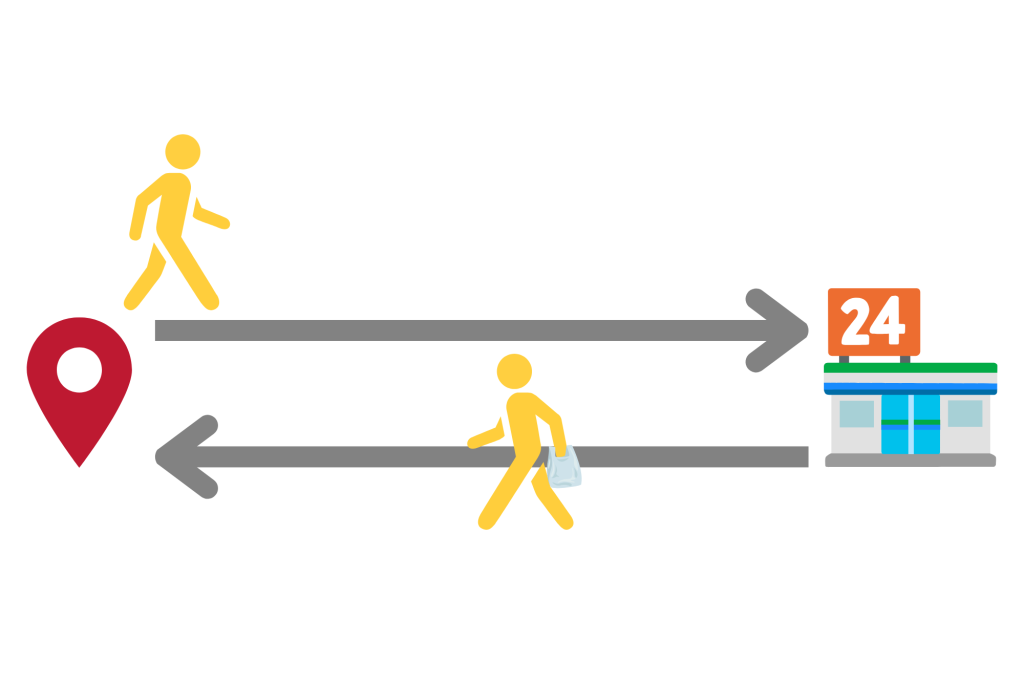
[Examples]
コンビニでジュースを買ってくるよ。
I’ll go buy some juice at the convenience store and come back.
駅員さんに行き方を聞いてくるから、ここで待っててね。
I’ll ask the station staff how to get there, so please wait here.
あそこでパンフレットをもらってきます。
I’ll go get a brochure over there and come back.
② Sequential Actions
This use describes doing something at one place and then moving on to another.
It’s similar to ①, but the difference is as follows:
① means “returning to the same place,”
② means “moving away from the starting place.”
In this usage, both “〜てくる” and “〜ていく” can be used.
Their meanings are:
“〜ていく”: movement away from the speaker or the current location
“〜てくる”: movement toward the speaker or the current location

[Examples]
病院へ来る途中で、花を買ってきたよ。
I bought some flowers on the way to the hospital.
⇒ [Starting point] flower shop (movement) → [Destination] hospital
日本に引っ越す前に、日本語を勉強していきます。
I’ll study Japanese before moving to Japan.
⇒ [Starting point] home country (movement) → [Destination] Japan
ここへ来るとき、郵便局に寄ってきました。
I stopped by the post office on my way here.
A社へ行く前に、昼ご飯を食べていきましょう。
Before going to Company A, let’s have lunch.
Summary
- “〜てくる” and “〜ていく” have a total of nine main uses.
- Use ① of “〜てくる” means to temporarily leave a place for a purpose, do something, and then return to the same place. *In this case, “〜ていく” is not used.
- Use ② of both “〜てくる” and “〜ていく” means to do something at one place and then move to another.
- The key difference is:① = returning to the same place, ② = moving away from the starting point.
Similer Articles
- JLPT N3・N4 Grammar – The difference between “〜あいだに”and “〜うちに”
- JLPT N4 Grammar – The difference between”〜みたいな” and “〜みたいに”
- JLPT N4 Grammar – The difference between “〜ようにする” and “〜ことにする”
- JLPT N2・N4 Vocabulary – The difference between “冷える” and “冷やす”
- JLPT N4・N5 Vocabulary – Difference between the counter “回” and “度”
▼ Subscribe to Our Newsletter ▼
Receive free tips for learning Japanese!


